|
California State Railroad Museum (CSRM)
2003 14th Annual Behind the Scenes Tour
May 10, 2003
By Matt Melzer of TrainWeb.com
http://www.trainweb.com/news/2003/2003e09a.html
Friday, May 9
I departed from Santa Cruz for Sacramento on the connecting bus to Amtrak Capitols train 534 at San Jose. The full train
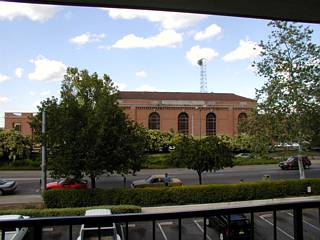
arrived into Sacramento at 3:40 PM, ten minutes early. I walked to the Vagabond Executive Inn Old Town to check into my
room, which was situated directly across the street from the ex-Southern Pacific Amtrak station. I walked past the CSRM
facilities through Old Town to find a railroadiana shop I had visited in the past. It, unfortunately, had gone out of
business and was replaced by a tacky souvenir shop! I inquired at a nearby antiques shop as to the presence of any train
stores. Shamefully, there were absolutely no rail-related stores besides CSRM's commercialized gift shop. Old Town
Sacramento (and, arguably, all of Sacramento) owes its very existence to trains, and yet the local business community
seems to find that fact irrelevent.
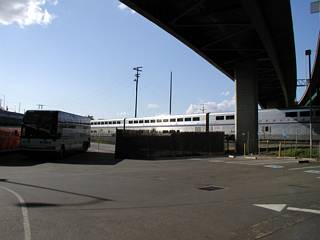
Walking back towards the Amtrak station, I saw train 5, the westbound California Zephyr depart across the I Street Bridge.
I looked for a place to have dinner at the Capitol Plaza Mall, but failed to find anything to my liking. I stopped briefly
at Cesar Chavez Park to see a blues band perform as part of a local municipal concert series, then walked again to Old
Town. I settled for dinner at Cosentino's Veranda, a pricey but excellent Italian restaurant overlooking Front Street. I
returned to my hotel room to bathe and watch train 14, the northbound Coast Starlight, do its station work thirty minutes
late. I even did my good deed for the day by alerting a station agent who had lost a few pieces of baggage off of her cart!
As I returned to my room, I saw that there was a hefty amount of police activity being staged on the western end of the
hotel property. It appeared that a lone car was being searched. I eventually got to sleep, in spite of the excitement.
Welcome!
Behind the Scenes Tour
California State Railroad Museum Foundation - May 10, 2003
Today's Behind the Scenes Tour will focus on the living legacy of the many people who built the railroaad and Sacramento.
The program will focus on railroaders who have made Sacramento's Old City Cemetery their lasting resting place - among
them Mark Hopkins, one of the "Big Four," and the engineer who was present for California's first train wreck on the
Sacramento Valley Railroad. In addition, we will be providing an update about the development of the Museum's new
(yet-to-be-named) labor and social history exhibit.
Today's Activities
8:00 a.m............Stanford Gallery Opens for Continental Breakfast and Registration
At registration, all guests will be given a "Boarding Pass" for a guided walking tour of Sacramento's Old City
Cemetery. For your enjoyment while you wait for your tour, we have displayed samples of the architectural drawings created
by the Historic American Engineering Record (a division of the National Park Service), a photo montage of the completed
Transfer Table and other current Museum projects.
8:30 a.m............Welcome and Introduction
8:45 a.m............Group 1 leaves for Cemetery on buses (Red Boarding Passes)
9:10 a.m............Group 2 leaves for Cemetery on buses (Green Boarding Passes)
9:35 a.m............Group 3 leaves for Cemetery on buses (Yellow Boarding Passes)
10:45 a.m...........Group 1 walking tour completed. We encourage you to enjoy and explore the Cemetery on your own. Buses leave
at 11:00 a.m., 11:15 a.m., 11:45 a.m., and 12:00 noon and you are responsible for returning to the bus in a timely manner
for departure
11:00 a.m...........First bus departs for the California State Railroad Museum from the entrance to the Cemetery
11:15 a.m...........Group 2 walking tour completed. We encourage you to enjoy and explore the Cemetery on your own. Buses leave
at 11:00 a.m., 11:15 a.m., 11:45 a.m., and 12:00 noon and you are responsible for returning to the bus in a timely manner
for departure
11:15 a.m...........Second bus departs for the California State Railroad Museum from the entrance to the Cemetery
11:15 a.m-12:45 p.m.Lunch buffet is available in the Stanford Gallery. If spare time permits enjoy the Museum's current
exhibits: "Toy Trains On Parade: A Preview of the Thomas W. Sefton Collection of Toy Trains," "Bringing Up the Rear: The
Disappearing Legacy of the Railroad Drumhead," and "Cathedrals of Labor: The Industrial Legacy of the Southern Pacific
Railroad Sacramento"
11:40 a.m...........Group 3 walking tour completed. We encourage you to enjoy and explore the Cemetery on your own. Buses leave
at 11:00 a.m., 11:15 a.m., 11:45 a.m., and 12:00 noon and you are responsible for returning to the bus in a timely manner
for departure
11:45 a.m...........Third bus departs for the California State Railroad Museum from the entrance to the Cemetery
12:00 Noon..........Last bus departs for the California State Railroad Museum from the entrance to the Cemetery
12:45 p.m...........Adjourn to the Museum's Theater Two for a presentation about the behind the scenes activities of the
development of the Labor & Social Histories exhibit which is being funded by a grand from the North American Railway
Foundation. Your purple sticker will admit you at the Museum ticket counter
2:00 p.m............Event concludes
3:00 p.m............Optional - you are invited to attend The Railway and Locomotive Historical Society's slide presentation
on the Central California Traction Company located in the Museum's Theater Two
Saturday, May 10
It was on this day 134 years ago, May 10, 1869, that the Union Pacific - Central Pacific Transcontinental Railroad's
golden spike was driven at Promontory Point, Utah. Today would be a mighty fine day for some railroad history lessons! I
checked out of the Vagabond Inn at 8 AM and took advantage of the complimentary continental breakfast only to grab
coffee. The breakfast room was packed with attendees of a police officer fraternity conference. After checking my baggage
at the front desk for the morning, I walked to the CSRM's
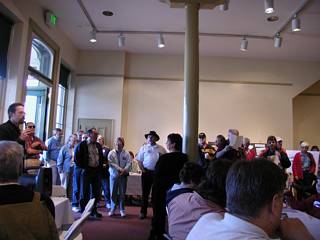
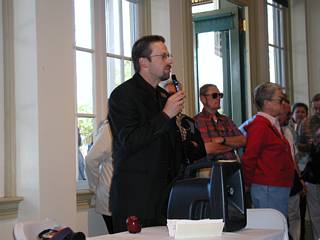
Stanford Gallery for a better continental brekfast with the hundred or so Museum members on hand. at 8:30 AM, Paul Hammond,
the Museum's Director of Marketing and Development, introduced the three tour guides that would be leading the three
groups to the Old City Cemetery, making for a very different kind of tour! TrainWeb's staff had attended two previous
CSRM Behind the Scenes Tours, both of which focused solely on local rail facilities. So, this year would certainly be a
change of pace.
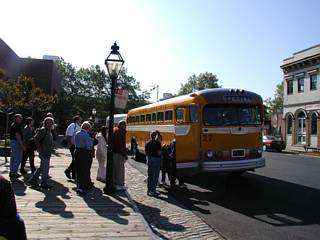
At 9 AM, I boarded with Group 2 on a 1949 General Motors transit bus, originally used by Union Pacific at Barstow, and
painted in immaculate UP yellow paint. We were accompanied by our tour guide, Steve, who handed us off to a cemetery tour
guide once we arrived. He gave background information on the cemetery, which was opened in 1849, making it the oldest
museum in Sacramento. John Sutter donated the first ten acres of the property after a cholera epidemic struck Sacramento.
The tour began under the leadership and narrative of Steven Drew, Chief Curator of the CSRM.
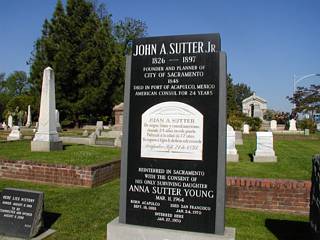
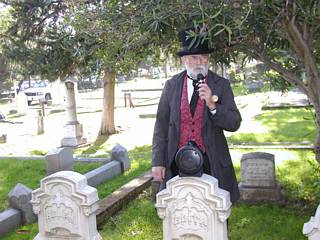
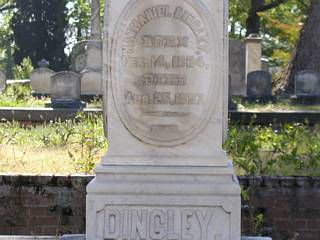
We were first taken to the grave of Nathaniel Dingley and his family. Dingley, who died in 1897, was a merchant who came
to California from Maine looking for gold (as most young men who came to California were doing at the time). After
coming up with only $2,000 and venturing in numerous businesses that failed due to structual fires, Dingley built a
"fireproof" building for his coffee, tea, and spice business. The building, which still stands to this day, is now owned by
the CSRM.
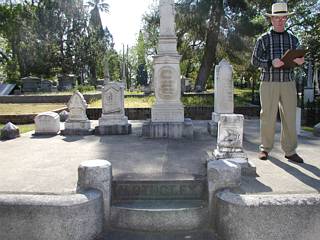
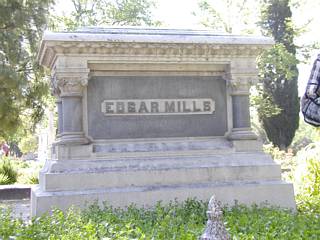
The next grave site we visited was that of Edgar Mills, who came to California with his brothers in 1850 in search of gold.
Instead, his brother D.O. Mills became a financier, opening a successful self-named bank, of which Edgar was president
for almost forty years. His specialty was financing railroads. As such, he was one of only nine guests personally selected
by the Big Four for the driving of the golden spike of the Transcontinental Railroad at Promontory Point exactly 134 years
ago. In fact, Governor Leland Stanford called upon Mills to plan the event.
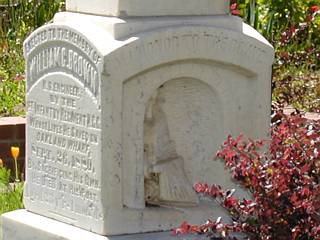
We next saw the grave of William C. Brown, a heroic locomotive engineer operating a passenger train at the Oakland Mole,
the terminus of the transcontinental railroad. He saw that the train was barelling towards a misaligned switch, but instead
of bailing out of the engine, he applied the brakes as best he could and stayed in the cab. The engine plunged into the
San Francisco Bay, killing Brown. As a result of his heroism, there were no passengers seriously injured.
The tour was taken over by Walter Gray, a CSRM staff member and, most notably, the California State Archivist. He first
took us to the unmarked grave of the Hanford family (no relation to the City of Hanford). A gentleman of the family whose
name I didn't catch was one of California's first locomotive engineers, working for the Sacramento Valley Railroad for
twenty-eight years. At year 26 (age 70), he got into a wreck in which water scalded over half his body. Nonetheless, he
recovered and returned to work. Two years later, his train hit a cow near Placerville and derailed. He died the next day.
His son, George E. Hanford, became an engineer for the Southern Pacific. On a southbound run out of Dunsmuir, his train
derailed and he died like his father. Indeed, occupation in the railroad industry was, at that time, the most dangerous
above-ground work in the world.
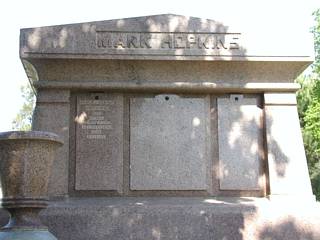
We next visited the grave of Mark Hopkins, one of the Big Four, who died on March 29, 1878. A partner of Collis
Huntington in the CP and SP railroads, Hopkins was supposedly the most humble of the Big Four. Born in Henderson, New York
(all of the Big Four were born in a twenty square-mile radius in Upstate New York), Hopkins assumed the responsibility of
supporting his family at the early age of 16, when his father died. He came by ship to California in 1849 searching for
gold, but returned to his original occupation as a merchant, opening a shop in Placerville. After numerous unsuccessful
ventures, Hopkins opened the most successful hardware wholesale company in the West with Huntington. Supporting the new
abolitionist, pro-Lincoln Republican Party in the 1850s, Hopkins made friends with Leland Stanford, helping him join the CP
as its treasurer upon its inauguration in 1861 until his death. Hopkins was vegetarian, spoke with a lisp, and married his
first cousin Mary. Unlike the other three of the Big Four, Hopkins never lived on a mansion in San Francisco's Nob Hill.
Even though Mary built one for him, he never lived in it, a testament to his humility. Hopkins was the first of the Big
Four to die, in his sleep, during an SP inspection trip. Interestingly enough, the origin of the choice to bury him in
Sacramento, instead of San Francisco or New York, remains a mystery.
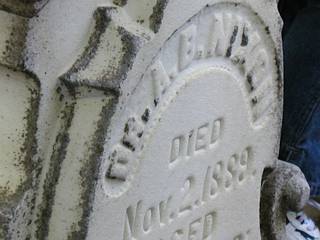
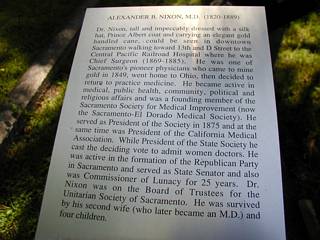
Next up was the grave of Alexander B. Nixon, Chief Surgeon for the CP Hospital, the first business-sponsored occupational
hospital in the West. Nixon was Mark Hopkins' personal physician. Ironically, Nixon accompanied Hopkins on what would be
his death trip, but Nixon retruned early because he thought Hopkins was healthy. Walter Gray tied the four preceeding
men together to illustrate a common thread of the important social history emobodied by the cemetery. With that, our group
was handed off to one final curator.
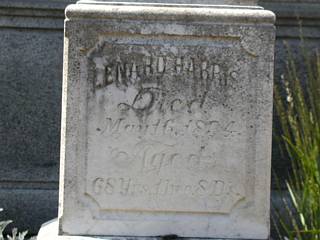
The grave of Len Harris came next. A 49er from New york, Harris became a railroad detective for both the CP and SP. In
1891, he and an associate were aboard a train stopped by the Dalton Grey gang of robbers. Harris survived being shot in the
neck, but never fully recovered. In a station robbery in 1895, he was shot again and killed. Harris has since been hailed
as a hero of an often-overlooked aspect of the railroad industry. His son, Len Harris, Jr., was a brakeman for the
Northern Pacific, and died at the age of 25 in a link-pin coupler accident.
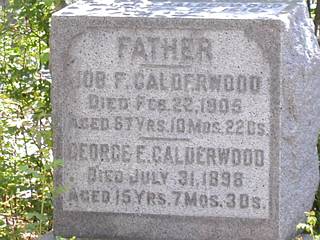
We then saw the grave of Job Calderwood, a conductor from Ogden, Utah to Oakland on a record-setting train that was to
travel from New York City to Oakland, normally a seven-day trip, in a mere 84 hours. The train was occupied mostly by
prominent Shakespearean actors, but extra tickets sold for $500. The train first ran from Jersey City to Chicago on the
Pennsylvania Railroad, then to Council Bluffs on the Chicago, Northwestern, & Pacific, and to Ogden on the UP. These
railroads switched locomotives at their normal division points, but CP wanted to save time on its portion to Oakland,
deciding to use only one locomotive: The 149, which was in the same class as the famed Jupiter. The engine had three
engineers and three firemen. The trip finished four-and-a-half minutes ahead of schedule, and it would be thirty years
before passenger trains regularly achieved those kinds of speeds.
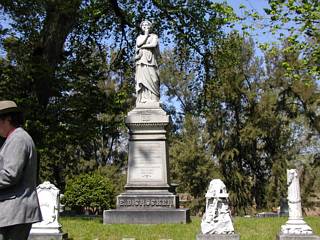
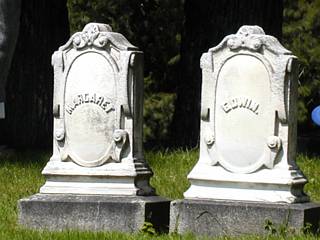
Finally, we visited the grave of Edwin B. Crocker, "Number Five" of the Big Four, the elder brother of Charles. Called
"The Judge," Edwin sat on the California Supreme Court, and was Attorney for the CP. He survived a stroke after
Promontory Point, went into semi-retirement, and became an art collector. He died in 1875, and his widow Margaret donated
his art collection to the City of Sacramento. The collection is now housed in the Crocker Art Museum. Edwin's son, William,
was a founding partner of the Sierra Railroad in 1897. In 1980, Charlie Crocker, the great-great grandson of Charles,
partially sold and donated Sierra's Jamestown shops to the State of California, to become today's Railtown 1897.
After the tour, I had just missed a departure of the yellow UP bus, but left at 11:25 AM on a chartered, smaller van
cutaway shuttle bus. We soon passed the yellow bus, broken down, with its full load of passengers still inside! I was
glad I missed it! Another charter bus was eventually dispatched to handle the stranded passengers. Lunch in the Stanford
Gallery consisted of varied sandwich platters. After eating, I returned to the Vagabond Inn to claim my bags. Walking
back to the Museum, I saw Amtrak train 6, the eastbound California Zephyr, arrive. Upon my return, Lexie Smith,
Development Coordinator for the CSRM Foundation, was kind enough to keep an eye on my bags at the registration desk.
After walking around the Museum for a while, I went to Theater Two for the 12:45 PM presentation. First to speak was Kathy
Taylor, Director of the California State Railroad Museum, who highlighted the recent achievements of the Museum. The
$500,000 transfer table was almost complete. $92,000 had been raised so far for the restoration of Sierra Railroad
locomotive #3, and an additional grant applied for from Save America's Treasures. The $1 million, 1000-square-foot
Thomas W. Sefton model and toy train exhibit would be nearing construction. Most crucially, however, would be the Labor
and Social History exhibit. It was no coincidence, said Taylor, that the cemetery tour had such a strong theme of the
human side and labor aspect of railroading. $486,000 had already been awarded for the new exhibit, with another grant
applied for from the North American Railway Foundation. The new exhibit would not be static or fixed, but would be
distributed throughout the Museum.
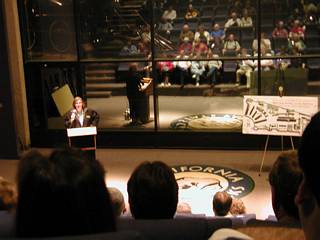
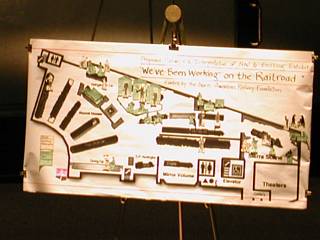
Taylor introduced Becky Caruthers, Project Manager for the new exhibit, the Museum's first new interpretive exhibit in
twenty years. She outlined the steps of the project's development, but emphasized the inherent fluidity. She discussed and
gave credit to the project team, and summarized the media that would be utilized: Twelve new mannequins, text, photos, and
audio/visual displays. There would be five main themes permeating the exhibit:
- Railroading and Community
- Race, Gender, Ethnicity, and Class
- Industry
- Evolution of Railroad Labor
- Workplace Safety
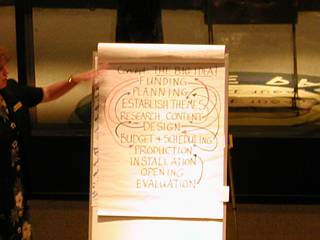
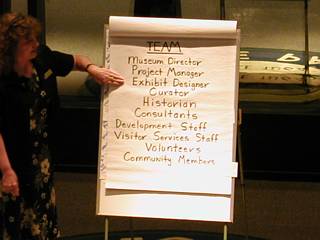
Caruthers reviewed the impending modifications to the Museum layout in detail, and declared an opening date range of
mid- to late-2004. After taking questions, she turned the floor over to Paul Hammond, who ended the Behind the Scenes
Tour just after 2 PM by polling the membership as to possible times and venues for next year's event, and by thanking
the members for their participation and support.
I quickly left for the Amtrak station to catch Capitols train 741 for San Jose at 2:40 PM. After a slightly late arrival
in San Jose, I was back in Santa Cruz before sundown, ending a fascinating, engaging, and educational trip to one of the
world's finest rail museums.
Click on the below links to view each set of photos:
Set #01 /
Set #02 /
Set #03 /
Set #04 /
Set #05
Photos from previous CSRM Behind the Scenes Tours:
1998
2001
Click here for the web site of the
California State Railroad Museum!
Click here for the web site of the
Sacramento Historic City Cemetery!
Questions? Comments? E-mail matt@trainweb.com .
|