|
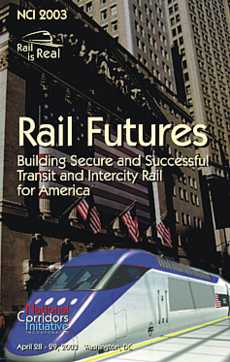
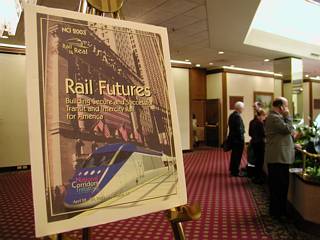
National Corridors Initiative 2003 Conference
Rail Futures: Building Secure and Successful
Transit and Intercity Rail for America
Washington Marriott - Washington, DC
April 28 - 29, 2003
By Matt Melzer of TrainWeb.com
http://www.trainweb.com/news/2003/2003d28a.html
My trip to the 2003 Conference of the National Corridors Initiative (NCI) was the first representation of TrainWeb at this key
annual event which routinely draws some of the most influential and important figures in the American passenger rail
industry. There were a few
changes to the lineup of speakers and guests, the most notable (and disappointing) having been the deletion of
Amtrak President and CEO David
L. Gunn. He was left little choice but to cancel his closing keynote speech at the end of day two of the conference, as he
was called to testify at a hearing on Amtrak's future before the US Senate Commerce, Science, and Transportation Committee
for that
morning (though the testimony was, of course, not scheduled to last all day, he had to clear his entire schedule should the
hearing run behind its schedule). Amtrak Chair Hon. John Robert Smith filled in Gunn's slot, vacating the final keynote
speaker slot for day one. The conference agenda below summarizes the events and speakers as they actually happened.
Monday, April 28th, 2003
7:30-9:00 am..Registration and Continental Breakfast
9:00 am.......Greetings: Jim RePass, President, The National Corridors Initiative
9:10 am.......Opening Keynote Address:
William G. Millar, President, the American Public Transportation Association
9:30 am.......Ross Capon, Executive Director, National Association of Railroad Passengers
10:00 am......Around the country: Reports from the Corridors
The Midwest: Rick Harnish, President, Midwest High Speed Rail Coalition
Texas/Southwest High Speed Rail: John Radovich, Texas Rail Advocates
Southeast: Pat Simmons, Director, Rail Division, North Carolina DOT
12:00-1:30 pm.Luncheon Speaker: Cesar Vergara, Chief Engineer, Jacobs Engineering
2:00 pm.......James Coston, Amtrak Reform Council, Coston & Lichtman
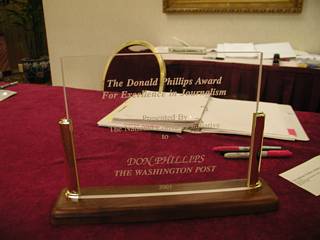
2:30-4:00 pm..Presentation of the Don Phillips Award - by William Vantuono, Editor, Railway Age Magazine
Panel on the News Media and Coverage of Transportation Issues:
Don Phillips, The Washington Post
Ledyard King, Gannett News Service
Molly McKay, Sierra Club Transportation Activist and Columnist, The Hartford Courant
Cliff Black, Director, Media Relations, Amtrak
5:00 pm.......Reception
Tuesday, April 29th, 2003
7:30-9:00 am..Registration and Continental Breakfast
9:00 am.......Greetings and Conference Opening, Day 2
Jim Brunkenhoefer, National Legislative Director, United Transportation Union
9:10 am.......Opening Keynoter: Amtrak Vice Chair Michael S. Dukakis
9:30 am.......Michael Replogle, Transportation Director, Environmental Defense
10:00 am......Anne Canby, President, the Surface Transportation Policy Project
10:30 am......Break
11:00 am......Joseph Silien, Senior Vice President, Parsons Brinkerhoff, and APTA Intercity Chair
Gil Mallery, Amtrak Vice President for Planning and Business Development
Matthew Hardison, Chief of Sales Distribution and Customer Service, Amtrak
12:00-1:30 pm.Luncheon Speaker: Rod Diridon, Chair, California High Speed Rail Authority
2:00 pm.......Funding a National Rail System: Industry Leader Panel
Chair, Michael Pracht, Railway Supply Institute Intercity Passenger Rail Committee
Donald Itzkoff, Principal, Foley & Lardner
Former Congressman Al Swift
Timothy Gillespie
3:00 pm.......Closing Keynote Speaker: Amtrak Chair John Robert Smith
As was the case in previous years, the conference was held at the Washington Marriott in the Foggy Bottom district on the West
End of Washington, DC, the obvious nucleus of passenger rail policy and development. Because, like many fellow conference
attendees, my time was far too limited to utilize any Amtrak service to travel to the nation's capitol, I would have to fly
jetBlue Airways, one of few "profitable" glimmers of hope in the languishing commercial airline industry, and America's
youngest major airline, from Oakland (the nearest jetBlue airport to my home in Santa Cruz) to Washington Dulles. On
Sunday, April 27, I arrived at Oakland International Airport from a Southwest Airlines flight from Burbank (having made an
impromptu visit to family in Southern California) at 7:50 pm, well ahead of the 11:20 pm departure of jetBlue flight 118 to
Dulles. In spite of the incessant torrential rain, the completely full red-eye flight departed a few minutes early. This
was my first flight on jetBlue, an airline that carries no pretenses about its austere service but touts its feature of
DirecTV in every seat of its one-class Airbus 320 planes. I got a small bit of sleep, and we arrived into Dulles at 7:09
am on Monday, April 28, six minutes early. I took the Washington Flyer bus to the West Falls Church Metro Station, and took
an Orange Line train to Foggy Bottom, arriving at the Washington Marriott at 8:30 am. (I could not help but notice the
streets strewn with flowers from the cherry blossom trees several blocks away on the National Mall.) I stored my duffel bag
with the bell captain and went upstairs for conference registration.
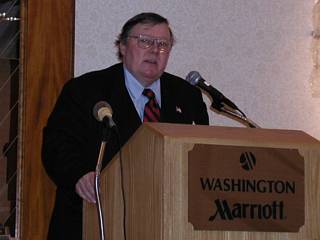
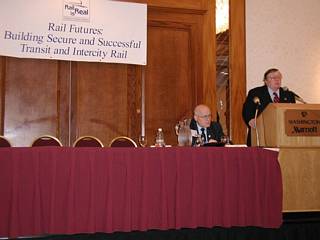
NCI President and CEO Jim RePass opened the conference promptly at 9 am, thanking the attendees for their participation in
spite of the general lack of willingness to travel due to the poor economy, the SARS virus, and the continued threats of
terrorism. He introduced keynote speaker Bill Millar, President of APTA, by admiring his ability to bring transit and rail
issues closer to the front of the American consciousness.
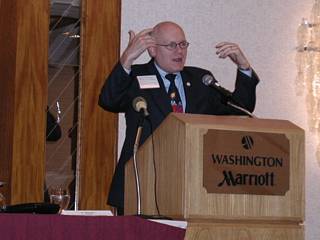
Millar opened his speech by insisting that each mode of transportation must be viewed in the context of all others, that
each mode can benefit one another, and that it is unwise to participate in the perceived dichotomies between rail advocates
such as ourselves and the highway lobby, for example. He pointed out that the "T" in APTA was changed from "transit" to
"transportation" to recognize the inherent interconnection between "urban transit" and other services such as Amtrak.
Though most of APTA's 1500 member organizations are in the United States and Canada, Millar personally welcomed two members
in the audience from Japan, and suggested that the international transportation community should put its heads together,
share ideas, and apply them locally. Millar was but the first of many speakers to call for a single, unified, coherent
national transportation policy. However, such an accomplishment is stifled by the fact that "our language is held
captive by modal silos," as in the lack of perception that Amtrak funding, for example, is seldom analyzed in the
mainstream as miniscule compared to the massive subsidies received by the other, and equally important, components of our
transportation system.
Millar praised Amtrak President and CEO David Gunn for creating hope for the future of intercity
passenger rail. With over a dozen pieces of legislation for rail development currently pending in Congress, Millar extended
his group's wishes that legislation beneficial to Amtrak's future be passed. However, the key piece of legislation likely
to be at the front and center of surface transportation interests is the
reauthorization of the Transportation Equity Act for the 21st Century (TEA-21), which allows states to fund 20% of transit
and related projects (including train station) and receive 80% matching grants from the federal government.
Noted Millar, the ripple effects of Amtrak's near-insolvency in June 2002 illustrated how intimately Amtrak is involved in
the operation
of many cities' own transit systems, due to the numerous commuter operating and/or maintenance contracts Amtrak holds. Many
such agencies' services would've been shut down had Amtrak, one of the few qualified commuter rail operators in America,
been forced to shut down itself. On a planning level, Millar alluded to the rising popularity of 'smart growth', that
some of the most successful transit systems have been integrated into urban development and redevelopment, and that often
central to their respective successes has been seamless connections to Amtrak or other transportation providers. To bring
all modes of transportation together is APTA's top priority for 2003. In 2002, APTA crafted its first-ever
passenger rail policy, which has in turn caused mutual interest and closer cooperation between parties in the transit
and intercity passenger rail industries of unprecedented quantity and magnitude.
Millar focused on the TEA-21 reauthorization efforts, in which APTA carries a tremendous stake. APTA supports the law
specifically because it provides a funding mechanism that offers generous federal contributions and local decision-making
previously unseen. APTA's official position is to support and expand TEA-21, namely to speed up the funding mechanism.
APTA believes in the famous adage 'build it and they will come'. Use of transit has increased 21% in recent years as many
TEA-21 projects have come to fruition. There were almost 9.5 billion rides on transit in 2002, which is the best since the
1950s, even in spite of the economy. However, to meet the growing needs of and demand for transit, public investment of
$14.3 billion will be necessary by 2009. Fortunately, noted Millar, TEA-21 has been a runaway success largely because 97%
of all promised funding has been delivered, a figure not always seen in federal grants. There has also been increased
public/private joint cooperation and financing (i.e. the Alameda Corridor), increased general interest in transit, and
faster transitions from planning to construction. APTA opposes the position of the Bush Administration that projects
currently financed at an 80-20 (federal-state) ratio under TEA-21 should become 50-50, and urges that the 80-20 ratio be
maintained.
Underscoring the power and relevance of public opinion, Millar shared the results of three recent polls. The first one,
underwritten, amazingly, by the American Road Builders Association in March 2003, showed that 74% of voters perceive a
national transit crisis, and that 60% would support modest gas tax increases to finance transit, flying in the proverbial
face of the myriad lawmakers who refuse to raise gas taxes to support anything but more road construction. A poll
underwritten by APTA showed that 80% of Americans see broad social benefits of integrated transit, and that nearly 2/3rds
would vote for candidates who promise more transit. Both numbers remained above 50% for all geographic areas, including
urban, suburban, small towns, and rural areas, providing compelling evidence that transit programs are not pork for elite
city dwellers. The final poll, commissioned, interestingly enough, by both the American Automobile Association and APTA,
showed that 93% of Americans feel that road congestion has become worse. 92% of the sample felt the need for alternatives
to roads. 25% of respondents used public transit in the last year, showing that transit also serves occasional,
non-commuting riders. Such demand for transit is indicative of how Amtrak may benefit.
Millar concluded his speech by pointing out that many rail advocates tend to be pessimistic, but that we must focus on our
countless positive achievements to build upon them, as "together, we can all make a difference." He then addressed
questions from the audience, repeating the need for continued support of local polling, planning, and decision-making, as
well as open-mindedness to all alternative modes, such as bikeways and walkways, which complement rail as well as any
other. Millar again repeated the need to find common ground with proponents of highways and the like, to find common
ground and work from there.
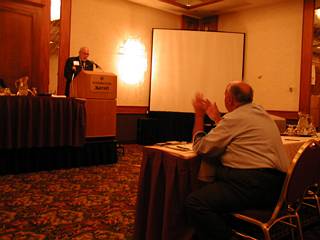
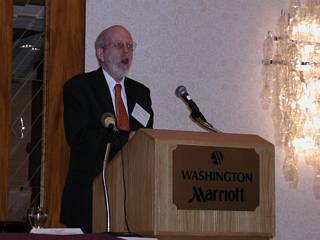
Jim RePass introduced the next speaker, Ross Capon, Executive Director of NARP, by hailing him as a hero and a friend of
our cause. Capon began by presenting the unprecedented addition of a passenger rail policy to the handbook of the
American Association of Retired Persons (AARP), which might never have happened were it not for the lobbying efforts of
NARP and other rail advocates. He then presented the American Passenger Rail Agreement (see
http://www.midwesthsr.org/summit/summit.html),
as well as the Coalition Principles for High-Speed Train Development
(see http://www.hsgta.com/documents/principles.pdf),
both of which are endorsed by numerous government agencies, the United Transportation Union, and countless rail interest
groups. Capon called Amtrak President Gunn and US Senator Kay Bailey Hutchison (R-TX), the key 'heartbeats' of passenger
rail, much the way the famed, late Amtrak President W. Graham Claytor was during his tenure.
Capon reminded the audience of the economic context in which Amtrak's current financial performance must be viewed, that
despite the staggering national increase in unemployment and stagnation, Amtrak continues to meet its targets for the
current fiscal year. It is these solid numbers, said Capon, that is what affords Gunn the grudging support of some of
Amtrak's harshest critics. Capon presented some of the ways in which Amtrak travel is becoming a better experience for
passengers, such as the stations which Amtrak has returned to full staffing after the
February 2002 Warrington cuts. He also mentioned the new train schedules, effective this same day, that reflect Gunn's
mandate to place passengers first, with faster and more convenient schedules (due, largely in part, to the removal or
substantial reduction of Express shipping service from numerous long-distance trains, which Amtrak proudly touts in its
new National Timetable).
Capon gave credit to the Surface Transportation Policy Project (whose President, Anne Canby, would speak the next day at
the NCI Conference). The STPP charter, which now has the support of 665 organizations, states that mobility should not be
based on car ownership or demographics, a message with which NARP strongly identifies. Capon concluded by praising Gunn's
newly released 5-year, $8-billion capital plan, noting that even Deputy Secretary of Transportation Michael Jackson, an
often harsh Amtrak critic, was not at all dismissive in his commentary on the plan.
Next to speak was the President of the Midwest High-Speed Rail Coalition (MHSRC) Rick Harnish, who began by tracing the
roots of his
organization to a commission charged by the State of Illinois in 1967 to further develop the Chicago - St. Louis corridor,
which remains the top priority of the MHSRC, thus continuing a tradition, but now with more concrete results to show for.
Harnish gave a two-part PowerPoint presentation, the first outlining the latest news of rail development in the Midwest,
state by state;
the second to financially and logistically illustrate the absolute necessity for the national network trains to feed,
complement, and share costs with the eventual Midwest Regional Rail network. Harnish announced that the first segment of
Midwest Regional Rail, Chicago - St. Louis, has $350 million in unfunded needs remaining, including more track work and the
eventual purchase of several new trainsets, but that the project remains on schedule.
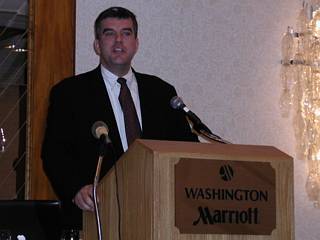
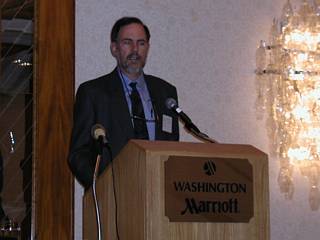
John Radovich of Texas Rail Advocates then spoke to update TRA's activities. He reaffirmed his and his group's support for
Senator Hutchison and her concern for the national Amtrak system, and that newly elected Senator Cornyn, who has become
more friendly towards passenger rail since being elected, continues to be "coached" on the issue. Radovich mentioned Texas
Governor Perry's lofty Texas Transportation Corridor plan, a massive, long-term, new highway and railway construction
project as a positive development, but warned that the Governor's office has yet to consult with rail experts, neighboring
states, or other relevant parties, leaving some holes in the plan. Radovich closed by pointing out that TRA advocates the
expansion of all forms of rail in Texas, not just Amtrak; specifically, that more NAFTA trade traffic from Mexico
that is routed through Texas should be carried by rail.
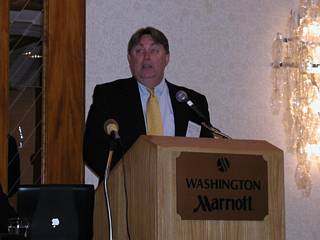
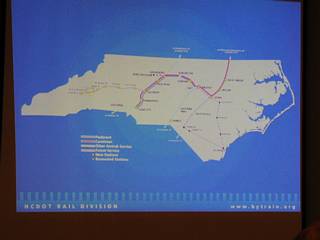
Rounding out the regional updates was Pat Simmons, Director of the Rail Division, North Carolina DOT. He called his office
a "great experiment" that remains timely -- North Carolina is second only to Texas in proportional highway miles, so there
remains much room for growth for the state's rail system. Simmons gave a presentation of the capital improvements that
have been ongoing along the routes of the Piedmont and Carolinian, namely station and track improvements. He was proud that,
once the work is complete, every single passenger station in North Carolina will be either new or renovated. Moreover,
many major grade crossings will have been eliminated or improved. Simmons then briefly introduced the Southeastern
Economic Alliance, a group composed mainly of chambers of commerce, that have joined forces to make the business case for
high-speed corridor development in the South to augment the national network trains. He made brief mention of North
Carolina Governor Easley's "Moving Ahead!" program, which will commit $700 million for state infrastructure improvement,
10% of which will go to transit and rail. Finally, Simmons touted his office's membership in the States for Passenger
Rail Coalition, which is comprised of 24 state DOTs advocating the creation of a federal funding partner to assist in
passenger rail projects which will collectively cost $4 billion, $3 billion of which will be needed within three years to
finance projects which are currently ready to enter the construction phase, pending funding. Member states also plan to
have a combined order of the same, yet-to-be determined, passenger equipment, which will be substantially cheaper than each
state or region purchasing its own equipment. The "S4PRC" is also seeking funding for studies and planning of more future
emerging corridors, and for infrastructure safety improvements.
The meeting soon broke for lunch, and I got a better idea of the conference attendees and their varied interests. There
were representatives from rail industry companies and government offices, as well as private citizens. TRAINS Magazine
passenger rail writer Bob Johnston was on hand as the only other member of the media besides myself and Leo King, the
Editor of NCI's weekly Destination : Freedom e-zine. In attendance was 11 year-old train enthusiast Saul Wilson, who
commanded much attention for being so astute in his complex knowledge of passenger trains.
(Click here to see Saul's train photo web site.)
Also present was Nikki Brown, a
third-year student at the University of California, Berkeley, who was in Washington DC for the semester as part of the
UCDC (University of California Washington Center) program. Part of the program involves writing a detailed research paper
on any topic of choice; Nikki decided to write about the past, present, and future of high-speed rail in the US, attending
the NCI conference to see and interview the many important figures central to her topic. As a pure coincidence, she was
inspired to undertake this particular research after reading a paper on the viability of privatizing Amtrak, written by
Joseph Henchman, one of my best friends! (Click
here to read Joseph's paper.) In fact, I would be staying with Joseph on Tuesday night after
returning to Oakland! Moreover, we learned that we grew up in the same neighborhood in Los Angeles, and knew many of the
same acquaintances, a reminder of how small the world truly is. Before lunch, I also used the opportunity to check into
my room at the Marriott, though I would not be able to get settled in until the end of the day's activities.
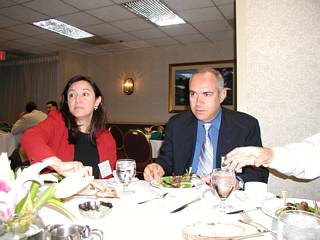
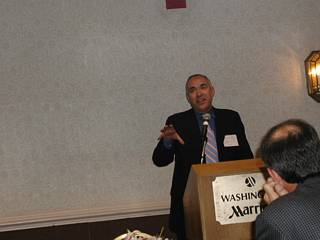
The luncheon was a fine meal of spring salad, seasoned fish, and chocolate cake. I sat with the luncheon speaker, legendary
designer Cesar Vergara of Jacobs Engineering; as well as Nora Friend, the Government Affairs Representative for Talgo
North America; a lady of the same position at Bombardier Transportation; William Vantuono, Editor of Railway Age Magazine,
Joseph Silien, Senior Vice President of Parsons Brinkerhoff and APTA Intercity Chair; Cliff Black, Director of Media
Relations for Amtrak, and Saul Wilson. Vergara made no effort to hide his exuberant personality, recalling
fascinating stories from his childhood in Mexico City and the time in which he first gained interest in trains. Vergara
soon rose to the podium to speak. He must be considered in the context that this is the man who, as chief designer for both
Amtrak and New Jersey Transit, single-handedly designed
many of the most famous, staple pieces of passenger rail equipment in America, such as the Amtrak Genesis series engine,
the interiors and exteriors of the Cascades and Las Vegas Talgo trainsets (including the famous streamlined fins on the
power cars), the new New Jersey Transit engines ALP-46 and PL42AC, and countless other vital projects. Vergara began his
speech by noting that design is at the heart of the presentability, or lack thereof, of any project, and rail is no
exception. Trains must be beautiful even before they exist, to generate outside aesthetic interest, among a public that
might not otherwise notice nor care. He showed a modern design book by the Smithsonian Institute that illustrated the
impact of artistic abstraction on the perception of a product. Included was a full page honoring Vergara's design of the
Talgo, which, Vergara said, was one of his greatest challenges. He worked to serve his customer, the State of Washington
DOT, while having difficulty not raising the ire of Amtrak, which objected to, or was skeptical of, many of his radical
design elements, such as the flashy fins designed to bridge the height gap between the F59PHI locomotives and the short
Talgo cars. However, the Cascades Talgo has proven to be a triumph, a runaway success that Vergara says belongs not to
him, but to the countless travelers who took interest in this new product because of its beauty. Vergara separated himself
from the many commercial designs featured in the Smithsonian book that were so abstract and outrageous that they were
irrelevant to the product being marketed (implicitly, much the way Amtrak's initial marketing for Acela Express was
perceived). According to Vergara, the common denominator in successful marketing has been the provocation factor, the
ability to rapidly generate interest and make people look twice. As his oft-quoted line goes, "Good design is good
business."
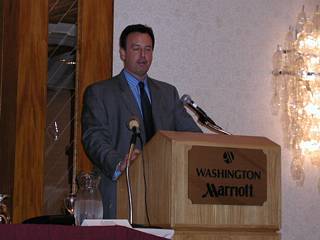
Jim RePass reconvened the general conference at 2 PM to warmly introduce James Coston, who served on the Amtrak Reform
Council (ARC) from 2000 until its dissolution in 2002. RePass regarded Coston as one of the greatest modern rail advocates,
and reminded the audience that it was Coston who founded the 20th Century Railroad Club, which at one point was Amtrak's
single greatest charter customer. Coston began his speech sarcastically describing the sorry state of the airline
industry, having flown (like many of us) to get to the conference. He also acknowledged the presence of Don Phillips
(who would soon be receiving his namesake's award from NCI), and reaffirmed his status as the authority on transportation
journalism. Coston recalled his experience serving on ARC, a group he described as having been designed to illustrate
Amtrak as a wasteful failure. He praised Amtrak's two previous presidents, George Warrington and Tom Downs, for having
done the best they could for the company, but summarized the fundamental mistakes Amtrak was making around the time of
his appointment to ARC by Senator Tom Daschle (D-SD) in 2000 (i.e. loser trains such as the Lake Country Limited). The
catch was, however, that discussion of Amtrak's faults was taboo in ARC, as that would have been to contradict ARC's real
mission. ARC could've demanded that Amtrak's management be held accountable for their actions, but would've rather let
Amtrak destroy itself so as to legitimize the idea of dissolving the company. That is how ARC, in its silence, did far
more harm than good for Amtrak. (Coston later pointed out that it was many of the ideas of the majority of ARC members
that fueled a rash of anti-Amtrak columns in such respectable, influential media outlets as the Wall Street Journal).
Coston called ARC's number one mistake its lack of response to the profitability myth, that the NEC could somehow pay for
itself, and that the national system is a cash drain. ARC failed to recognize that the popularity and historical success of
the NEC is not a result of demographics, but money.
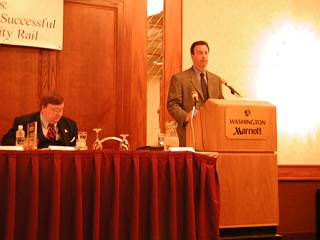
Coston describes Amtrak's political dilemma as having been that Amtrak has had no enemies nor friends, only critics and
apologists, none of whom would care enough to challenge the status quo. That is why Amtrak President Gunn deserves so much
credit, for single-handedly undoing past mistakes and bringing real reform to the company. Coston digressed into the issue
of ownership of the Northeast Corridor (NEC), noting that ARC recommended the NEC be spun off from Amtrak, but failed to
recommend the essential capital funding mechanism. In other words, it doesn't matter whether or not Amtrak owns the
railroad, it needs proper public investment no matter what. While Coston rejoiced at Gunn's capital plan, he expressed
anger that Gunn has to go through so much trouble to request money for a railroad whose states served do not contribute a
penny, and whose tracks are used 92% by non-Amtrak commuter trains. The inherent problem is that there is no permanent
source of capital funding that takes into account all parties involved. Though several non-NEC states pay heavily for their
Amtrak services, Coston expressed the notion that states should not have to pay, simply because they, in many cases, no
longer could.
By neglecting Amtrak, Congress and the President are, according to Coston, ignoring and defying the wishes of their
constituents, as most Americans clearly want a national Amtrak system to be preserved and expanded. Coston drew a large
analogy between today's situation with passenger rail and the situation of the early 1950s with commercial aviation. He
pointed out that there was then a growing demand for air travel (much the way there is for rail travel today), without
the infrastructure to support it. Though President Truman in 1946 drafted plans for a national aviation system,
President Eisenhower ignored the plans, stocking his cabinet with cronies representing the interests of ground
transportation. It took the advent of the Boeing 707, the Black Wednesday airline system meltdown of 1954, several
deadly crashes due to insufficient radar and air traffic control systems, and the election of President Johnson, before the
FAA and DOT were finally created in 1964 to oversee and maintain civil aviation.
Coston urged the audience to take away three lessons from the aviation experience:
1) That federalizing transportation systems takes a very long time, as Congress is not very keen on long-term planning.
September 11th, 2001 should've been a wake-up call to strengthen our national Amtrak system, but that has yet to happen on
a large scale. However, we must continue to pursue our goals, as it is the rail advocates who will have the most sensible
plans ready to deploy once the government finally wakes up to our country's realistic needs. Coston pointed out that
it was the continuous work of airline advocates that allowed aviation plans to be implemented rapidly, and that the same
will hold true for rail. However, real progress can come only with a stable funding and planning mechanism.
2) That we must hit hard on the shortcomings of the airlines, not to point fingers, but to highlight the system's many
deficiencies that would be solved by expanded investment in rail.
3) That we must celebrate and use our achievements to date to educate the public as to why rail should be explored further.
Such successes as the Amtrak Capitol Corridor illustrate how a modest investment can yield rapid growth and a traveling
public more satisfied with its options.
Coston expressed his full confidence that anti-rail attitudes in the government will pass, that the public wants to travel
and more passenger rail will be inevitable. Said Coston, "If one administration doesn't [invest in rail], the next one
will. Last time I checked, we still have elections in this country."
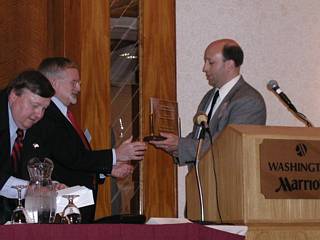
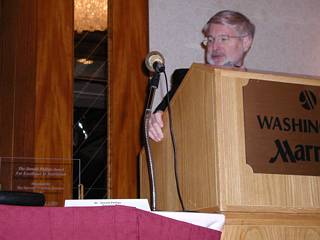
Jim RePass called upon William Vantuono, Editor of Railway Age Magazine, to present the first annual Don Phillips Award for
Excellence in Journalism to Don Phillips of the Washington Post. Vantuono acknowledged his mentors and fellow journalists,
and said to Phillips, "You never cease to amaze me." With that, Don Phillips graciously accepted the award named in his
honor, calling it the highest honor since he was given an award for his journalistic excellence in flight safety.
Phillips then joined Vantuono, who would lead the Panel on the News Media and Coverage of Transportation Issues, along with
Ledyard King of the Gannett News Service, Molly McKay of the Sierra Club and the Hartford Courant, and Cliff Black,
Director of Media Relations for Amtrak. Vantuono began by expressing his frustration on the lack of knowledge of
transportation, especially railroad, operations among journalists, especially considering that most press organizations
used to have dedicated, knowledgeable railroad reporters.
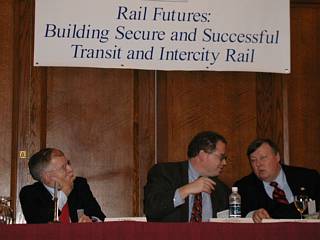
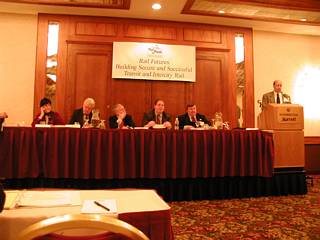
Don Phillips said that ignorance of trains is obviously nothing new, and that the top priority of concerned members of the
media must be to simply let people know that trains exist. He suggested that a special effort be made to educate members of
law enforcement, as they often serve as important sources of information for journalists after such incidents as
derailments. Phillips pointed out that even the railroad industry itself has timidly acknowledged the need for more
public awareness, hence the Association of American Railroads' recent general ad campaign. Vantuono led questions for the
panel. Much of the discussion was focused on Amtrak's train route losses should be reported in the news (this would become a
hot issue once again on Tuesday during Amtrak Chair John Robert Smith's speech). Vantuono responded that if falsehoods
or misrepresentations are printed, it is the responsibility of more enlightened journalists to "do something about it."
With no final keynote speaker for Monday, Jim RePass adjourned day one of the conference at 4:18 PM. I retrieved my
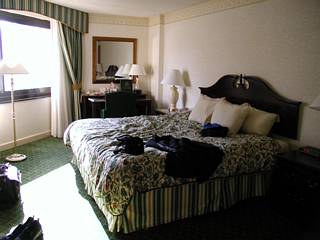
duffel bag from the bell captain, and went to my room, 466, to get settled in. My large, tasteful, comfortable room had a
lovely view of the corner of M and 22nd. I took a shower, got dressed, and got caught up on my e-mail, before meeting up
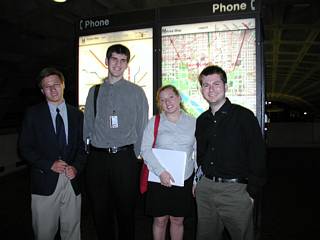
with Nikki, who I would introduce to my friends Harris Cohen and Adam Otsuka, who are also both avid rail advocates and
enthusiasts, and would certainly be excellent primary sources for her paper! Harris and Adam both attend the University of
Maryland near Washington DC, and had already arranged to meet me at the Marriott so that we could all go to dinner. They
eventually showed up, and Adam generously gave me a copy of the previous Friday's Don Phillips article on David Gunn and
his new capital plan. Harris, who interns at Amtrak's Government Affairs office, brought a copy of the actual plan. We all
walked to the Foggy Bottom Metro Station, taking the Blue Line to L'Enfant Plaza, and transferring to the Yellow Line to
Archives. We walked from there to Stacks DC, an excellent kosher deli, where we were all very well fed. We then walked to
the Metro Center, where Harris and Adam caught the Red Line to return to College Park, and Nikki and I took it in the
opposite direction to Gallery Place / Chinatown and walked to the UCDC building so that I could get a quick tour. I took a
pleasant stroll through Washington's West End to return to the Marriott, and after wrapping up the day's work, went to
sleep at 11:30 PM.
I was up at 8 AM, giving me just enough time to get dressed, check out, store my duffel bag once again, and enjoy the
continental breakfast before the start of the day two of the conference. I spoke briefly with Leo King, who said
readership of NCI's D:F publication has steadily increased, due in no small part to his ability as a retired Amtrak
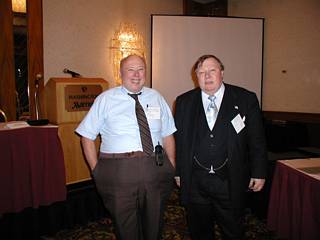
employee to consistently publish a quality newsletter every single week. Amtrak Vice Chair, former Massachusetts
Governor and presidential candidate Michael Dukakis soon arrived, and I soon greeted him and thanked him for taking his
time to come speak to our group. We agreed in our hopes that the voters of California pass the $9.95 billion bond measure
in November 2004 that would finance initial construction of the California high-speed rail system. He pointed out,
however, that if 80% federal matching grants were available, construction of the entire system would be financed!
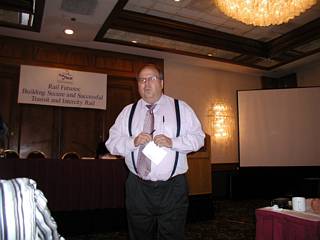
Jim RePass began day two just after 9 AM, with many conference attendees missing, deciding instead to attend the Senate
Commerce, Science, and Transportation Committee hearing on the future of Amtrak to see David Gunn testify. RePass
introduced Jim Brunkenhoefer, National Legislative Director for the United Transportation Union, who refused to stand
behind the dais to speak, instead pacing the floor. Brunkenhoefer played the oil card, focusing on the fact that the oil
on which we are so dependent originates largely from the countries with which were are most hostile, all in the name of
'economic convenience'. He found it peculiar that we go through such great lengths to bring home this oil, which will
ultimately give us cancer. No reasonable government would approve of this arrangement, said Brunkenhoefer, but that
many politicians and citizens simply fail to understand reality. This reality will only become starker as time
progresses, until leaders of society look to us rail advocates for long-term solutions.
Speaking of the solutions, Brunkenhoefer urged us to own up to the fact that the potential of passenger rail will not be
realized without cooperation with certain interest groups. Freight railroads, for example, should not be expected to be
helpful without the potential for benefit to their own infrastructure, such as public investment in track upgrades. He
also made clear that no progress can be made without unions such as his, as unions are the one major voting bloc in
America that almost unanimously support Amtrak and passenger rail. He pointed out that there are at least 45 Senators who
would vote for an Amtrak bill, not necessarily because it benefits Amtrak, but because it benefits the unions. He soon
introduced 'the man who should've been President', Michael Dukakis.
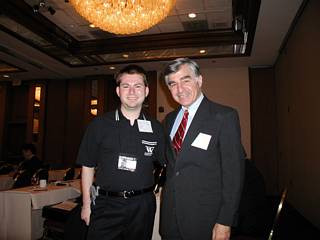
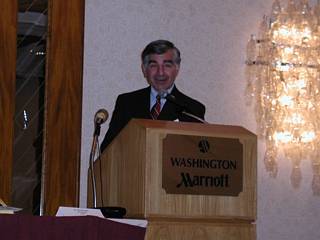
Exuberant as he had ever been, Amtrak Vice Chair Michael Dukakis made a point to mention that he came to Washington DC
from Boston that morning
aboard the inaugural run of Amtrak's new Federal (a name originally coined by the Pennsylvania Railroad and once previously
used by Amtrak), which replaced the popular Twilight Shoreliner on a more favorable overnight schedule. He also gave his
shameless endorsement to Senator John Kerry (D-MA) for President in 2004, who, according to Dukakis, would be the ideal
candidate to trust for constructing high-speed rail across the country. "I trained him well," joked Dukakis, referring to
Kerry's term as Lieutenant Governor of Massachusetts while Dukakis was Governor.
Dukakis reflected on his last five years on the Amtrak board, as his term will soon expire, with little chance of
reappointment by President Bush. Dukakis defended Amtrak's effort to obey the Congressional self-sufficiency mandate from
the Amtrak Reform and Accountability Act of 1997, as it was not an option to defy their appropriators and risk losing all
funding. He said most problems would have been avoided to begin with had a dedicated, federal source of capital been
created, which is still essential, and which would help minimize Amtrak's operating loss. Dukakis hailed David Gunn (who
worked under him at Boston's MBTA) as the 'best railroad guy in America', having set the stage for Amtrak's reauthorization
debate by cultivating credibility and pressing to stabilize the national system. He lamented that much was learned from the
experience of procurement of the Acela Express trainsets, namely that the wisest idea is to purchase new trainsets off the
shelf, and not depend on manufacturers to properly implement the plans. He pointed out that, years ago, before the
electrification of the NEC north of New Haven, a Talgo trainset made the trip from Boston to New York in less than three
hours, which is faster than Amtrak would even like Acela Express to eventually run!
Illustrating the importance of public capital funding in attracting high ridership even in a weak economy, Dukakis pointed
out that the California corridors would never have been so successful without the over-$1 billion in state investment over
the past few years. The same experience has also been had on the Cascades, which has seen nearly flawless operations since
the introduction of Cesar Vergara's new Talgo trainsets in 1998. Returning to the central theme of a dedicated capital
funding source, Dukakis showed confidence that the majority of the Senate would support such a plan, a plan that could be
especially popular because of the ability to implement it without raising taxes. To put his argument into the context of
the rest of our country's transportation system, Dukakis pointed out that an amount of only 8% (or $4 billion) of the other
modes' appropriations would be sufficient for national rail needs. Like many rail advocates in recent times, Dukakis
expressed amazement that our tax dollars are already funding the rebuilding of Iraq's railways, which proves the need for
and vitality of rail, a fact that our government has obviously already admitted, but refuses to apply at home.
Dukakis praised Gunn's new capital plan, which is reform itself. He questioned the meaning of the Amtrak Reform Council's,
or the Bush Administration's, ideas of 'reform'. The rhetorical question Dukakis wishes the public to ask is, "Is reform
more highways and airports?" He affirmed his strong belief in the free market, but feels our lopsided transportation
experience clearly demonstrates how the free market does not at all apply. Dukakis expressed agreement with Gunn that
the idea of Amtrak naysayers to separate operations and infrastructure is "loony," and that competitive bidding on
individual routes would not increase efficiency. He was nostalgically sad that Amtrak did not bid to renew its contract
with MBTA, but understands that Amtrak could not stomach the increasing liabilities. However, Dukakis noted that the new
consortium that will operate MBTA (the Massachusetts Bay Railroad Company, or MBCR), will receive $45 million more per
year than Amtrak did to provide the same service, combined with an imminent fare increase!
Dukakis reiterated the need for federal matching grants, even for the national network trains, and pointed out that the
operating subsidy Gunn is requesting for the next five years for those trains is only about $400 million per year, which is
'chump change'. Dukakis expressed his gratitude to Jim RePass and NCI for fighting the good fight, and ended by
underscoring the need for education of the public of the modest price and high efficiency of rail, as is shown by the plans
for Florida high-speed rail. Dukakis had to leave immediately after his speech, as he had to catch an Acela Express back to
Boston to teach his political science class that day at Northeastern University, but the attendees were clearly grateful
for his presence.
Next to speak was Michael Replogle, Transportation Director for Environmental Defense. Like so many of his peers, Replogle
praised the environmental benefits of TEA-21 and the strong increase in transit use since its inception. Not surprisingly,
he unequivocally called for the reauthorization and strengthening of the TEA-21 program, which is further justified by the
fact that air pollution continues to increase. Though the United States accounts for 5% of the world's population, we
consume 1/3 of all energy used for transportation. While TEA-21 is not the final word on mitigating these factors, it is
essential for progress to continue. Replogle also called for an increase in data collection, analysis, and public planning
to aid in the stewardship of natural resources. He mentioned a slew of figures demonstrating exactly how environmentally
sound rail and transit are. He suggested that annual federal transit funding should be doubled, and that a strong
high-speed rail system be built to support the national Amtrak system. In short, "We've got to stand up and call for
parity." Replogle also echoed the message that the California experience has shown that a modest investment yields
tremendous results.
Replogle shifted to transit growth, illustrating how recent transit development has become vital to the development and
prosperity of numerous cities such as Portland (Oregon), San Jose, and Denver. He noted that transit benefits local
water reserves, park, endangered species, and other finite resources, and that train stations or transit centers serve
far more passengers than do airports, with exponentially less land. He also warned of the highway lobby's efforts to reduce
the already-lax environmental review process for highway construction. Replogle pointed out that the key to realizing
common goals through TEA-21 has been better interagency coordination for all of the public and private entities involved.
The strategy of 'smart growth' should be expanded and encouraged, said Replogle, especially in light of the fact that the
share of jobs reachable without private automobiles has actually declined in recent years, a trend that must be reversed if
we are to live the American ideal (and law) of equal opportunity. Parking tax incentives and car insurance rate structures
must be reformed to promote commuting by transit, said Replogle. Disincentives to walk or bike actively contribute to our
nation's epidemic of obesity, and Replogle reminded that all alternative modes of transportation, including walkways and
bikeways, should be integrated into the nation's transit systems. Replogle concluded by reaffirming that TEA-21 contributes
to travel choices, human health, and protecting the environment.
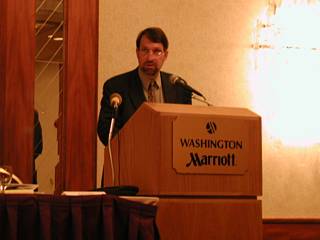
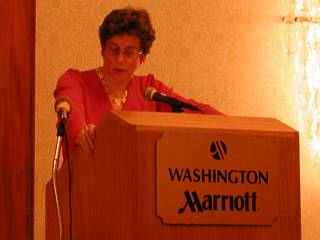
These same themes were echoed by Anne Canby, newly appointed President of the Surface Transportation Policy Project (STPP),
who described the STPP as a new, broad-based coalition, mainly of environmental groups, that helped enact TEA-21. Canby
picked up where Replogle left off in illustrating room for improvement, noting that the ratio of highway funding to
transit funding has worsened, a fact that she found to be disturbing. She said that a major "logjam" has been the
perception that the roles of state DOTs is limited to highways (a notion that was clearly disproved in such states as
California, Illinois, and North Carolina, to name a few). Canby demanded that modes of transportation cease to be analyzed
individually, and that transit must be incorporated to the analysis of traffic patterns and trip types to mitigate
unnecessary automobile use. She suggested more local control of transportation dollars, and for the federal government to
allow states to decide where their highway money goes (as, under current law, highway appropriations must be spent on
highways and not rail). Having been the Secretary of Transportation for the State of Delaware, Canby assured the audience
of her expertise on the matter.
Canby repeated the notion that the people are ahead of the politicians, and that we must enlighten the politicians to aid
them in catering to the true needs of their constituents. She spoke very kindly of David Gunn, who, according to Canby, has
given credibility not only to Amtrak, but to the entire cause of balanced transportation. The bottom line, said Canby, is
that we must carry the message of what we and the American people want, accepting that it's a matter of money, and that
the issues must be faced head-on.
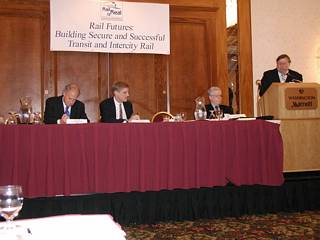
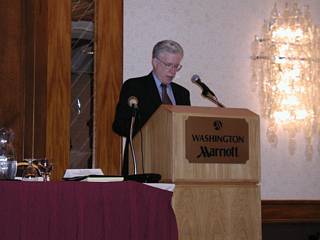
Rounding out the morning's activities was a panel on near-term Amtrak and rail corridor growth, led by three experts in the
area: Joseph Silien, Senior Vice President of Parsons Brinckerhoff, and Chair of APTA's Intercity Rail Committee; Matthew
Hardison, Chief of Sales Distribution and Customer Service for Amtrak; and Gil Mallery, Vice President of Planning and
Business Development for Amtrak. Silien began by elaborating on the vision of Bill Millar and APTA for passenger rail,
outlining APTA's 10 principles. The one that is currently most important to APTA, according to Silien, is #5: "Do not
jeopardize current funding sources for public transportation." Matt Hardison focused on the gradual but
developing connectivity between airports and rail systems, which he sees as the weakest intermodal link today. Hardison
called for rail connections to be integrated into airport planning, and not become low-priority afterthoughts.
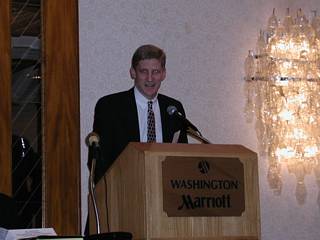
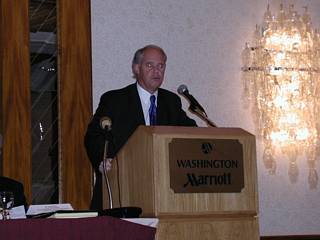
Gil Mallery, who became a hero of sorts to many rail advocates during his tenure as the can-do President of the
now-defunct Amtrak Western Business Unit, focused on his experience prior to holding that post. Before joining Amtrak
West, Mallery headed the State of Washington DOT's Division of Rail, and was instrumental in making the Amtrak Cascades
corridor a reality. He noted that the legacy of the initiation of the Cascades lives on, and that the State of Washington
had just approved a 10-year, $300 million incremental improvement plan for the Cascades that would include hourly service
between Seattle and Portland, a running time of 2 hours 30 minutes, and a staggering 2 million riders per year.
Like a long-protected trade secret, Malley revealed his 10 keys to successful corridor development:
- 10. Seamless connections to other modes.
- 9. More aggressive, targeted marketing.
- 8. Increased train frequencies.
- 7. Strong customer service and amenities.
- 6. Competitive trip times.
- 5. New equipment (for the "shiny new train" effect).
- 4. Reliable, on-time performance.
- 3. Grassroots support.
- 2. Cooperative host railroads (see 4).
- 1. Incremental improvements to meet long-term goals.
Mallery concluded by expressing support for Gunn's capital plan, which underscores Amtrak's commitment to improve and
stabilize the
current system, as no new service expansions are included in the plan. He also called for states to step up and stand
together with Amtrak, as all new partners are welcome and make a difference.
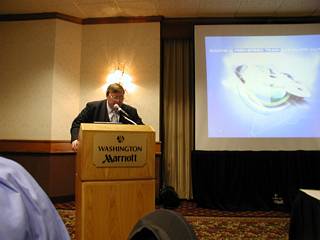
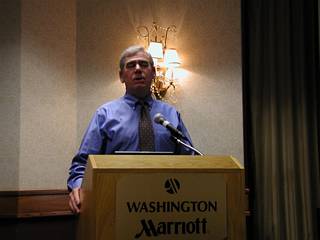
The meeting was adjourned for a luncheon of caesar salad, chicken, rice, and cheesecake. At my full table, I sat next to
the lunchtime speaker Rod Diridon, Chair of the California High-Speed Rail Authority (after whom San Jose's Cahill
Street SP Station was renamed). He was soon introduced by Jim
RePass to present the ambitious project. Diridon began by sending the message that California's high-speed rail system will
be more than the single largest construction project in the history of the United States (by double), it will be an
investment in our children's future, and must be marketed as such. The fact remains that, whether or not the system is
built, the population of California, which is already the most populous state in the union by far, will double, and that
there will be vital needs to be met. The high-speed rail system will focus growth and development to discourage urban
sprawl, along with the obvious environmental and mobility benefits. Diridon gave a brief background
on his agency and its staff, and highlighted the legal mandate his agency must follow in developing high-speed rail: That
the trains will operate at speeds of 200 mph or greater, that the system will be 100% grade separated, and that all major
California cities will be served. In other words, if built, it would be a world class system, rivaling even France's
venerable TGV. On the November 2004 ballot in California will be a bond measure, already passed by both houses of the
legislature and signed by Governor Gray Davis, authorizing the issue of $9.95 billion in general obligation bonds, $9
billion of which would finance the initial phase of construction of the high-speed rail system, the other $995 million of
which would be used to improve existing rail and transit systems. Diridon indicated that, if the measure is passed, the
State of California will request $9 billion in matching grants from the federal government. The first $18 billion should be
sufficient to construct and open the first segment, from Los Angeles to San Francisco (a trip that will take about two and
a half hours) by year 2012.
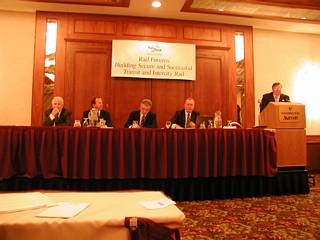
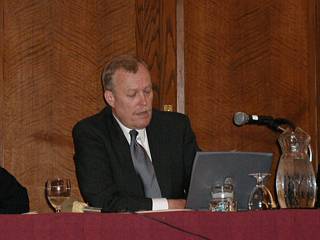
For its final session, the meeting was reconvened by Jim RePass to introduce "Funding a National Rail System: Industry
Leader Panel," chaired by Michael Pracht, Chair of the Passenger Rail Committee of the Railway Supply Institute (RSI).
He summarized the formation of the RSI by the consolidation of the former Railway Progress Institute (RPI) and Railway
Supply Association (RSA) organizations, with the obvious intent of building a strong coalition of rail industry leaders.
He expressed his eagerness for his committee to be front and center in the push to lobby for passenger rail legislation,
particularly a tax credit bond bill, which would be presented in greater detail by Timothy Gillespie. Pracht distributed
his testimony from that morning's Amtrak hearing before the Senate Commerce, Science, & Transportation Committee (see
links at end of story to read all testimony), demonstrating his seriousness in wanting his group's voice to be heard by the
lawmakers.
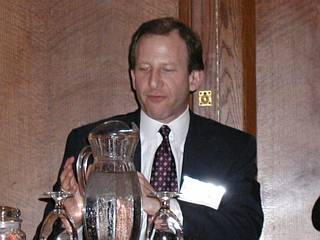
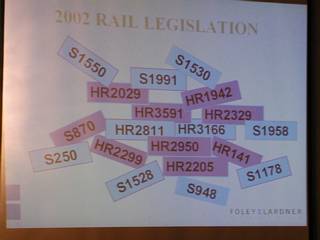
Donald Itzkoff, an attorney with a distinguished history in rail transportation, discussed the ideological shift regarding
Amtrak funding between the Clinton and Bush administrations, compared the Bush and Amtrak proposals for fiscal year 2004
Amtrak funding, and showed the small fraction of transportation spending for which Amtrak would account next year. Itzkoff
also summarized the hodgepodge of various Amtrak reauthorization and rail spending bills currently on the table for both
houses of Congress, segueing appropriately into Timothy Gillespie's remarks on funding mechanisms.
Gillespie, former Vice President of Government Affairs for Amtrak, noted that the most fruitful successes during his
20-year tenure were not appropriations, but tax bills. He also pointed out that federal transportation spending was altered
fundamentally with the passage of TEA-21, as 30% of spending became discretionary to the USDOT, taking clout away from
the otherwise powerful Congressional appropriations committees. Gillespie expressed pessimism that the benefits of the
National Defense Rail Act (S.1550, a comprehensive Amtrak funding bill, sponsored by Senator Ernest Hollings [D-SC]),
would probably not be realized even if it passed, simply because the funds included might never be released by the
appropriators. Obvious challenges include skyrocketing deficits and other programs competing for the same monies. The same
dilemma applies to states, which current carry a collective debt of about $80 billion.
That is why the Railway Supply Institute is backing a new solution to the passenger rail funding quandary: The creation of
the Rail Finance and Development Corporation (RFDC), which would be a public-private issuer of tax-credit bonds, much like Fannie
Mae, up to $50 billion for rail infrastructure projects of all sorts (Northeast Corridor, ports, Class I railroads,
shortlines, etc.) This proposal, which was developed by the American Association of State Highway and Transportation Officials
(AASHTO), would be introduced to Congress within two weeks, probably on the floor of the Senate.
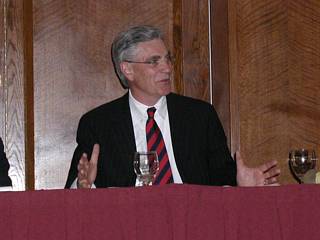
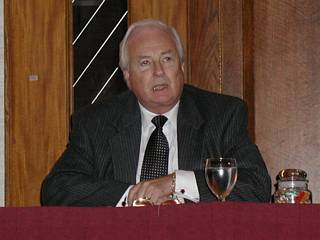
Former Congressman Hon. Al Swift (D-WA) repeated the theme of the importance of educating politicians about the benefits of
rail, saying flatly, "The United States is passenger-rail illiterate." After all, said Swift, it's challenging to sell
specific ideas when the politicians have little grasp of the basic ones, such as the fact that rail is often the single
most cost-effective solution for countless transportation problems. Yet, day in and day out, legislators attack rail as
costly. He blamed Congress for the Amtrak situation, using the analogy that if you beat a dog enough, it will, not
surprisingly, behave strangely. Swift repeated the need for a unified message from passenger rail advocates, but a succinct
message of no more than three points. Most importantly, such a message must be effectively spread to the movers and shakers
outside of our own familiar circles. He said with confidence that such a message is emerging, and that the RSI is a vital
contributor to the effort. Swift stressed that incremental improvements should be pressed before high-speed rail to
"re-establish rail into the consciousness" of the relevant parties. In other words, we must crawl before we can walk.
When panel took questions, Gillespie noted that rail infrastructure development through the RFDC would effectively
address the criticism that President Bush's proposed tax cuts may not effectively stimulate the economy. However, if some
of that money was to be redirected instead to tax credits through the RFDC, tangible benefits would be enjoyed by the
entire economy through a strengthened national rail system.
The final keynote speaker, the Honorable John Robert Smith, Mayor of Meridian, MS, and Chair of Amtrak, was
enthusiastically introduced by Jim RePass. RePass outlined Smith's involvement in the National Corridors Initiative, with
Smith having joined the board in 1995. After his appointment by President Clinton to the Amtrak board in 1997, Smith was
elevated to Chair of the National Corridors Initiative.
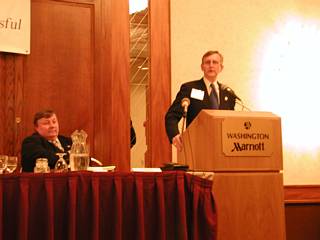
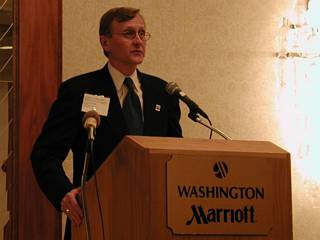
Smith, after being greeted with a hearty round of applause, began his speech emphasizing the need for a bipartisan
effort to save and strengthen Amtrak. He gave a brief background on his February 2002 appointment as Chair of Amtrak after
the post was vacated by the newly appointed Secretary of Health and Human Services Tommy Thompson. He also reflected on his
board's April 2002 search for a new President of Amtrak following George Warrington's resignation. Smith recounted that,
while several candidates were interviewed, David Gunn stood out from the start, never compromising in his famous candor.
Gunn said flatly that he would operate the entire Amtrak system, or nothing at all. Smith admired Gunn, that his
"[honesty and candor have] won him the respect of Capitol Hill."
It is often said that Gunn is very frugal in every way, and Smith was obliged to provide yet more anecdotal evidence to
support that belief. Smith recalled that, during the week-long loan negotiations with the DOT in June 2002, when Smith had
to stay in Washington DC for an indefinite amount of time, Gunn would take Smith's one pair of clothing home with him
every night to launder it himself, so that Smith or Amtrak wouldn't have to pay to have it laundered! Smith, was, of
course, also quick to praise Gunn's ability to bring home the bacon, flying in the face of the pundits who felt Amtrak
could never have received its requested FY 2003 appropriation of $1.2 billion from Congress and the White House. Yet, as
everyone knows, Amtrak received nearly that amount, and is putting the money to work to improve the current system. Smith
expressed confidence that this trend will continue, and that Gunn's new capital plan will lead Amtrak for the next five
years. Smith noted that specific dollar amounts and a detailed plan are key to Congressional approval, and highlighted the
simplicity and honesty of the plan by reading aloud some of the dollar amounts contained for various projects.
Smith equated Gunn with real reform, insisting that even if "reform" is crafted by the federal government, the national
network must continue to operate. However, Gunn's current reform programs are helping Amtrak find common ground with the
DOT, as no one should argue with Amtrak putting its resources into the basic, critical needs of the system. Smith expressed
hope that the capital plan would also be a starting point for a long-overdue debate over the future of Amtrak and a national
transportation policy. However, warned Smith, the plan is not designed to bring Amtrak to profitability, but that it will
simply allow for a properly maintained national system to remain in place until the lawmakers aid in creating a long-term
plan for growth.
"Rest assured," said Smith, "David [Gunn] is a man you can trust, ...and he will run a national system about which you will
be proud."
Taking questions, Smith was compelled to address the issue of loss per-passenger, a measure of financial performance which
makes long-distance trains look like money-losers, and which is used by countless Amtrak critics, especially in Congress,
to justify eliminating long-distance trains. Such numbers were repeated over and over during that morning's Senate hearing,
despite Gunn's dismissal of such numbers as a 'red herring'. Smith repeated that these numbers do not matter, considering
that the fact remains that only $300 million of Amtrak's current annual budget is used to subsidize the non-Northeast
Corridor national system. I, however, pressed Smith to address the fact that Amtrak's naysayers will continue to use the
loss per-passenger figures no matter what he or anyone else says about such figures. I asked Smith to provide specific,
alternative numbers, such as loss per-passenger-mile, so that we as rail advocates can take these numbers into our
respective communities and spread the truth about Amtrak's long-distance trains. Smith deferred my question to Gunn, saying
that I would have to contact him personally to request such numbers. [As of publication date, a request for Amtrak's
financial performance data is pending.]
Jim RePass thanked Smith and all of the attendees, closing the National Corridors Initiative 2003 Conference at 3:40 PM. I
thank both Smith and RePass personally after the meeting, and left for the Foggy Bottom Metro Station to return to Dulles
Airport. I took an Orange Line train to its terminus in Vienna, where my friend Justin picked me up to drive me to Dulles.
The first thing I noticed was that there were no automated ticket kiosks for JetBlue Airways (or any other airline for
that matter), as there are at most airports. In fact, I prefer to use such machines to avoid waiting in lines and dealing
with possibly unfriendly employees at the ticket counters. Fortunately, there was no line, and I had my boarding pass
quickly. Upon asking the ticket agent why there were no kiosks, he pointed and said, "This is IAD. The White House is over
there." As I had suspected, a convenience to travelers had been sacrificed in the name of homeland security, because of the
airport's obviously close proximity to so many important national institutions. After bidding Justin farewell, I boarded
JetBlue flight 119 to Oakland. This flight was much more comfortable than the flight to Dulles, as I had a roomy exit row
seat, with no one occupying the middle seat. The flight was made yet more interesting by a spectacular thunderstorm visible
over Colorado, which I feebly attempted to photograph. We arrived into Oakland at 11:25 PM, on time, and I took the AirBART
bus to the Coliseum / Oakland Airport BART Station, where my friend Joseph was waiting for me. We took a Richmond train to
Berkeley, thus affording me the opportunity to ride in one day my two favorite rail transit systems: The Washington Metro,
and BART.
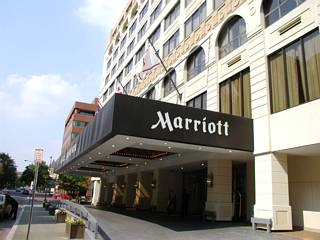
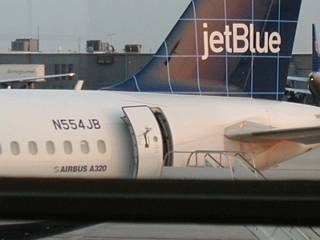
And so ended my grueling but fascinating and informative trip to the National Corridors Initiative 2003 Conference. The
success of the conference lies in the fact that the dire need to educate America's politicians is finally being recognized.
From my personal perspective, the largest hindrance to such enlightenment has been the lack of accountability on the
part of the mainstream media. The media must be held liable for its blind complicity in the ideologically-based, rampant
biases
against rail, and for recklessly accepting the countless lies and myths about passenger rail, simply because it represents
the ongoing political inertia to ignore the need for a long-term, balanced transportation policy. The media is central to
our oft-mentioned need for education. If rail returns to America's consciousness, and the media questions the politicians
who act not on behalf of their country, but to serve special interests, we would have a very different, and much-improved,
nation, one built on economically and environmentally sound, long-term development of all viable options for mobility.
The country's standard of living would be improved, and our nation's businesses would function more efficiently.
The Ecologist, a monthly British publication focusing on environmental economics and politics, features in volume 33,
issue 3 a list of "30 steps to an oil-free world." Eight of the thirty steps at least indirectly involve promoting use of
rail and modes of transportation alternative to roads and airways. The benefits of rail and rail transit are tremendous and
irrefutable. If our nation is to realize these benefits, we can begin with the allies and supporters of rail fostering and
promoting the few alternative points-of-view that are espoused, particularly through such rare news outlets as TrainWeb.
Click on the below links to view each set of photos:
Set #01 - Flight to Washington, Jim RePass, Bill Millar, Ross Capon
Set #02 - Rick Harnish
Set #03 - John Radovich, Pat Simmons
Set #04 - Luncheon with Cesar Vergara, James Coston, Journalism Panel with Don Phillips
Set #05 - Room at Washington Marriott
Set #06 - Jim Brunkenhoefer, Hon. Michael Dukakis, Michael Replogle, Anne Canby
Set #07 - Joseph Silien
Set #08 - Matthew Hardison, Gil Mallery
Set #09 - Rod Diridon
Set #10 - Michael Pracht, Donald Itzkoff, Timothy Gillespie, Hon. Al Swift
Set #11 - Hon. John Robert Smith, Flight to Oakland
Related Links:
Questions? Comments? E-mail matt@trainweb.com .

|